




Trying to figure out Medicare enrollment can feel like navigating a maze blindfolded. Between the confusing alphabet soup of acronyms-IEP, GEP, AEP-and the constant worry about missing a critical deadline, it’s easy to feel overwhelmed. The question of when can you get Medicare isn’t just about turning 65; it’s about a series of specific windows of time. If you choose the wrong one, you could face lifelong late enrollment penalties or unexpected gaps in your health coverage, especially if you plan to keep working.
Our goal is to give you peace of mind. This simple guide is designed to remove the confusion and provide the straightforward guidance you deserve. We’ll walk you through each key enrollment period, step-by-step, so you can understand exactly which one applies to your unique situation. By the end, you’ll have a clear timeline and the confidence to enroll at the right time, ensuring you steer clear of costly mistakes and secure your health coverage without the stress.
Key Takeaways
- Your most important opportunity to enroll is during your Initial Enrollment Period, a specific 7-month window around your 65th birthday.
- Discover if you can safely delay Medicare enrollment without penalty if you plan to continue working past age 65 with employer health coverage.
- Missing your sign-up window can be costly; learn the dates for the General Enrollment Period and how to steer clear of lifelong late penalties.
- Answering when can you get Medicare is just the first step; find out about the annual periods that let you adjust your coverage as your needs change.
The Main Event: Your Initial Enrollment Period (IEP)
Navigating the world of Medicare can feel overwhelming, but understanding your key deadlines is the first step toward confidence. If you’re wondering when can you get Medicare, the most critical time to know is your Initial Enrollment Period (IEP). Think of this as your personal, one-time welcome window to sign up for Medicare. Acting during this period is the single best way to ensure you get the coverage you need without facing potential lifelong penalties.
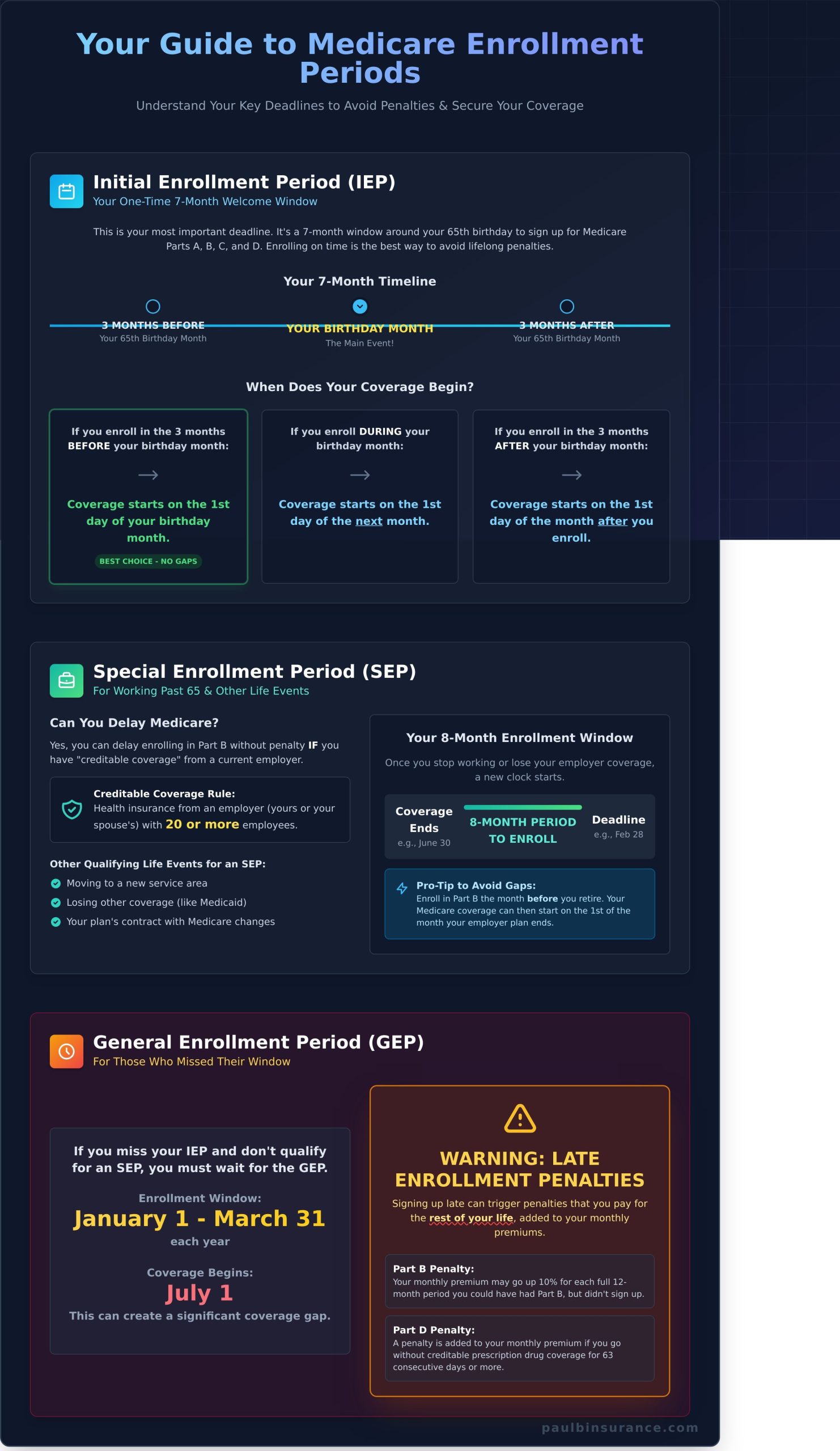
Your IEP is a 7-month window built around your 65th birthday. It works like this:
- It begins 3 months before the month you turn 65.
- It includes your birthday month.
- It ends 3 months after the month you turn 65.
For example, if your 65th birthday is in June, your IEP starts on March 1 and ends on September 30. During this time, you can sign up for Part A (Hospital Insurance), Part B (Medical Insurance), Part D (Prescription Drugs), or a Medicare Advantage Plan (Part C).
What is the Initial Enrollment Period?
Your IEP is your primary opportunity to enroll in the federal Medicare program. This period is specifically for those who are newly eligible, which for most people means turning 65. However, you can also become eligible for Medicare due to a disability. If you are under 65, you will get an IEP after you have received Social Security Disability Insurance (SSDI) benefits for 24 months.
How to Calculate Your 7-Month Window
Understanding when your coverage begins depends on which part of your IEP you enroll in. If you sign up in the three months before your birthday month, your coverage will start on the first day of your birthday month, ensuring a seamless transition. Enrolling later means your coverage will be delayed.
Note: If your birthday is on the 1st of the month, your IEP and coverage start one month earlier.
| If you enroll during… | Your coverage will start… |
|---|---|
| The 3 months before your 65th birthday month | The 1st day of your birthday month |
| Your 65th birthday month | The 1st day of the next month |
| The 3 months after your 65th birthday month | The 1st day of the month after you enroll |
Consequences of Missing Your IEP
Failing to enroll during your IEP can lead to two major issues. First, you could face significant gaps in your health coverage, leaving you financially vulnerable. Second, you may have to wait until the General Enrollment Period (which runs from January 1 to March 31 each year) to sign up, with coverage not starting until July 1. This delay can also trigger late enrollment penalties for Part B and Part D that you could pay for the rest of your life.
Working Past 65? Understanding the Special Enrollment Period (SEP)
One of the most common questions we hear is, “Do I have to sign up for Medicare if I’m still working at 65?” The answer is often no, but it depends entirely on your current health coverage. The question of when can you get medicare without penalties becomes much simpler when you understand the rules around delaying your enrollment.
If you have health insurance from your (or your spouse’s) current job and the employer has 20 or more employees, you likely have what Medicare calls “creditable coverage.” This allows you to delay enrolling in Medicare Part B without facing a late enrollment penalty down the road. This flexibility is managed through a Special Enrollment Period (SEP).
What Qualifies as a Special Enrollment Period?
A Special Enrollment Period is a window of time outside of your Initial Enrollment Period when you can sign up for Medicare. These are triggered by specific life events. While the most common reason is leaving a job and losing employer-based health coverage, other events can also qualify, such as:
- Moving to a new address that isn’t in your current plan’s service area.
- Losing other coverage, like from Medicaid.
- Your current plan changes its contract with Medicare.
How to Use Your 8-Month SEP for Employer Coverage
Once you stop working or lose your employer health plan, your 8-month Special Enrollment Period begins. Let’s walk through an example: If your last day of work is June 30th, your SEP starts on July 1st and runs for eight full months, ending on February 28th of the following year. To avoid any gaps in coverage, it’s wise to enroll in Part B the month before you retire. This way, your Medicare coverage will start on the first of the month your employer plan ends.
Avoiding Penalties: The Creditable Coverage Rule
This rule is your key to avoiding lifelong late enrollment penalties for Part B. However, it’s crucial to understand the details. Not all health plans count. For example, COBRA and retiree health plans are not considered creditable coverage for delaying Part B. Sticking with these instead of enrolling in Medicare can lead to significant penalties. Understanding the nuances of these Medicare enrollment rules is vital. Even if you delay Part B, most people should still sign up for premium-free Part A when they first turn 65.
Missed Your Window? The General Enrollment Period (GEP) and Late Penalties
Figuring out when can you get Medicare is a critical first step, but sometimes life gets in the way and deadlines pass. If you missed your Initial Enrollment Period (IEP) and don’t qualify for a Special Enrollment Period (SEP), please don’t panic. Medicare provides a safety net, but it comes with important rules and potential costs you need to understand to make the best decision for your health and finances.
What is the General Enrollment Period?
The General Enrollment Period (GEP) is an annual window for individuals who should have signed up for Medicare Part A and/or Part B but did not. This period runs from January 1 through March 31 each year. It’s crucial not to confuse this with the annual Open Enrollment Period in the fall, which is for changing existing plans. The GEP is specifically for starting your Medicare coverage after missing your initial window.
However, there’s a significant drawback: even if you enroll on January 1, your coverage will not begin until July 1 of that year. This gap can leave you without crucial health coverage for several months, which is why timely enrollment is always the best and most secure strategy.
Understanding Late Enrollment Penalties
Beyond a delay in coverage, enrolling during the GEP often means facing late enrollment penalties. These aren’t one-time fees; they are ongoing additions to your monthly premiums that can last for the rest of your life, making a simple oversight a costly mistake.
- The Part B Late Enrollment Penalty: This is the most common penalty. For every full 12-month period you were eligible for Part B but not enrolled, your monthly premium will increase by 10%. If you waited two years, for example, you would face a 20% penalty added to your premium, every single month, for as long as you have Part B.
- The Part D (Prescription Drug) Late Enrollment Penalty: A separate penalty applies if you delay enrollment in a Medicare prescription drug plan and go without other creditable drug coverage.
Navigating these complex rules can feel overwhelming. The specifics of each enrollment period are detailed in the official Social Security Administration guide to Medicare enrollment, but applying them to your unique situation can be a challenge. You don’t have to sort through it all alone. Confused about penalties? Let an expert help you navigate the rules.
Key Dates for Existing Medicare Beneficiaries
Once you’ve answered the initial question of when can you get Medicare and are successfully enrolled, your journey with healthcare coverage isn’t over. Your health needs, prescription medications, and even your preferred doctors can change from year to year. Recognizing this, Medicare provides annual windows for you to review your coverage and make sure it still provides the best value and support for your life.
Understanding these periods is key to managing your healthcare with confidence. Here are the most important dates to mark on your calendar.
Medicare Annual Election Period (AEP / Open Enrollment)
This is the main event each fall for reviewing and changing your coverage. The AEP runs from October 15 to December 7 every year. During this time, you have the flexibility to make several key changes, which will take effect on January 1 of the next year.
- Switch from Original Medicare to a Medicare Advantage Plan.
- Change from one Medicare Advantage Plan to another.
- Leave a Medicare Advantage Plan and return to Original Medicare.
- Join, drop, or switch a Medicare Part D prescription drug plan.
Medicare Advantage Open Enrollment Period (MA OEP)
This period, running from January 1 to March 31, offers a second chance to make a change, but only if you are already enrolled in a Medicare Advantage Plan. If you are unhappy with the plan you chose during AEP, you can make one change during the MA OEP. Your options are to switch to a different Medicare Advantage Plan or drop your plan and return to Original Medicare.
Your One-Time Medigap Open Enrollment Period
This is arguably the most critical enrollment period for those considering a Medicare Supplement (Medigap) plan. It is a personal, six-month window that starts on the first day of the month you are both 65 or older and enrolled in Medicare Part B. During this one-time period, you have a guaranteed issue right to buy any Medigap policy sold in your state, regardless of your health history. Insurance companies cannot deny you coverage or charge you more for pre-existing conditions. Missing this window can make it much harder and more expensive to get a Medigap plan later. Because rules can vary by state, getting trusted guidance is crucial. If you have questions about your specific situation, we can help provide clarity. You can learn more at paulbinsurance.com.
Your Next Steps to a Clear Medicare Path
Navigating the Medicare timeline can feel complex, but it all comes down to a few key moments. Understanding when can you get medicare is centered on your unique situation. For most, this means acting during the seven-month Initial Enrollment Period around their 65th birthday. For others still working, a Special Enrollment Period provides a crucial, penalty-free window. Missing these deadlines can be costly, making it vital to know which path applies to you and to act on time.
Feeling overwhelmed by the dates and deadlines? You don’t have to figure this out alone. As an independent agency that has provided trusted guidance to over 5,000 clients, we’re here to simplify your Medicare journey. We offer unbiased advice on plans from over 40 trusted carriers, ensuring you receive the personalized, year-round support you deserve. Let’s simplify your Medicare journey together. Schedule your free, unbiased consultation today.
With the right support, you can move from confusion to confidence and step into your Medicare coverage with complete peace of mind.
Frequently Asked Questions About Medicare Enrollment
Can I get Medicare at age 62?
This is a common point of confusion, but typically, you cannot get Medicare at age 62 based on age alone. While you can start receiving Social Security retirement benefits as early as 62, Medicare eligibility begins at age 65 for most people. The main exceptions are if you have a qualifying disability, End-Stage Renal Disease (ESRD), or Amyotrophic Lateral Sclerosis (ALS). We can help you understand the specific rules that apply to your unique situation.
Am I automatically enrolled in Medicare when I turn 65?
You will be automatically enrolled in Medicare Part A and Part B only if you are already receiving Social Security or Railroad Retirement Board benefits when you turn 65. If you are not yet collecting these benefits, you must actively sign up for Medicare yourself. Taking this step during your Initial Enrollment Period is crucial to avoid potential late enrollment penalties down the road. It’s always best to confirm your status to ensure a smooth transition.
What’s the difference between the General Enrollment Period (GEP) and the Annual Election Period (AEP)?
These two periods can be confusing, but they serve very different needs. The General Enrollment Period (GEP) from January 1 to March 31 is for individuals who missed their initial chance to sign up for Part A and/or Part B. In contrast, the Annual Election Period (AEP) from October 15 to December 7 is for people already enrolled in Medicare to review and change their Medicare Advantage (Part C) or prescription drug (Part D) plans for the upcoming year.
When is the best time to sign up for a Medigap (Medicare Supplement) plan?
The absolute best time to buy a Medigap plan is during your 6-month Medigap Open Enrollment Period. This one-time window begins on the first day of the month you are both 65 or older and enrolled in Medicare Part B. During this protected period, insurance companies cannot use your health history to deny you a policy or charge you higher premiums. Missing this window can make it much more difficult or expensive to get a plan later on.
How do enrollment periods work if I qualify for Medicare due to a disability?
If you qualify for Medicare due to a disability, your enrollment timeline is tied to your disability benefits. Most people are automatically enrolled in Part A and B after receiving Social Security Disability Insurance (SSDI) for 24 months. Your 7-month Initial Enrollment Period happens around this 25th month, giving you the opportunity to choose a Medicare Advantage or Part D plan. Understanding when can you get Medicare in this situation is key to seamless coverage.
Do I have to sign up for Part D prescription drug coverage when I first get Medicare?
While Medicare Part D is optional, we strongly advise enrolling when you first become eligible. If you delay signing up and don’t have other creditable drug coverage (like from an employer), you will likely face a permanent late enrollment penalty if you decide you need a plan later. Enrolling on time protects you from this penalty and ensures you have coverage when you need it, even if you don’t currently take many prescriptions. It’s a crucial step for your financial peace of mind.