
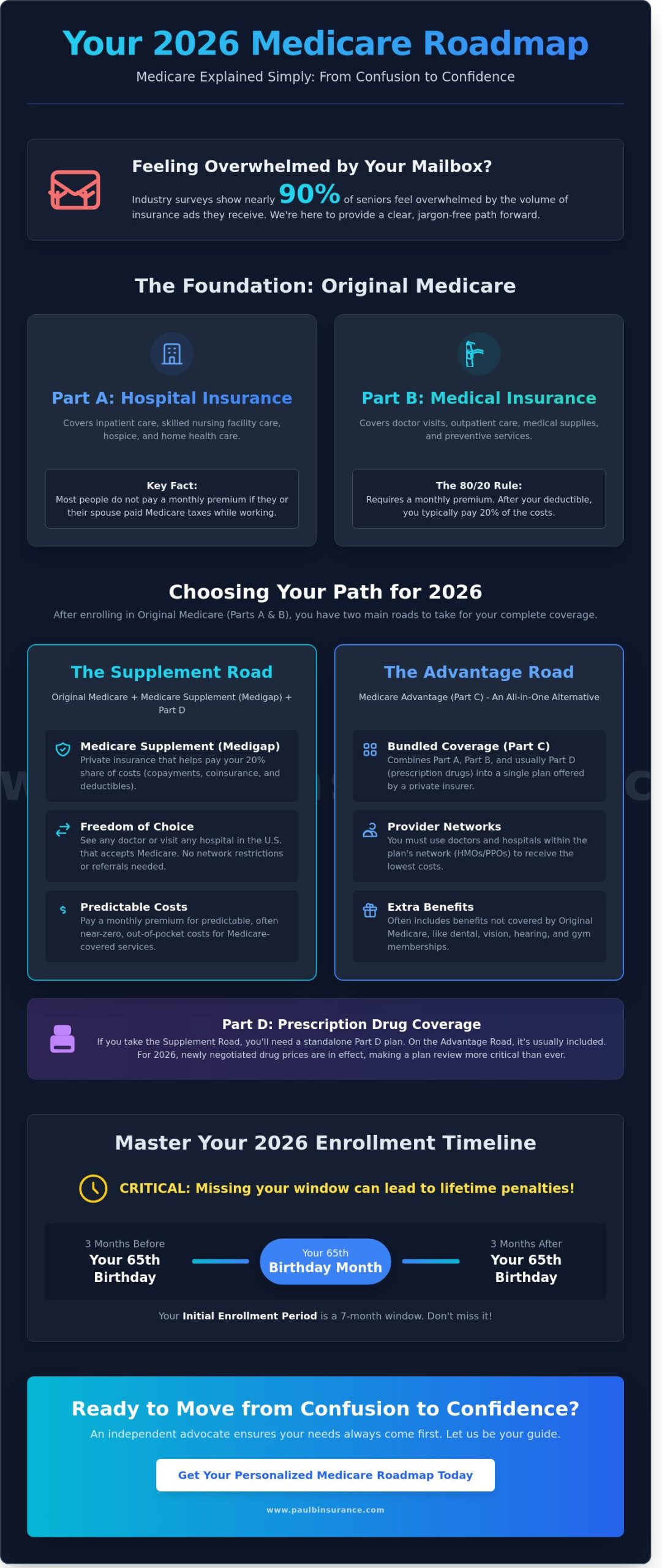
What if your mailbox wasn’t a source of stress every single morning? According to industry surveys from early 2026, nearly 90 percent of seniors feel completely overwhelmed by the volume of insurance advertisements they receive. We know that this mountain of paperwork and the constant TV commercials don’t provide clarity. They only create a maze of confusion. You want to feel protected, not pressured. We believe you deserve a clear path where medicare explained simply for seniors is the standard, not the exception.
We agree that the fear of getting stuck in the wrong plan is a heavy burden to carry. That’s why we’re stripping away the insurance jargon to give you a stress-free roadmap to your 2026 options. In this guide, we’ll walk you through the four parts of Medicare, show you the real differences between Supplements and Advantage plans, and ensure you never miss a critical deadline. You’re about to move from a state of confusion to total confidence.
Key Takeaways
-
Learn how to decode the "alphabet soup" of Parts A, B, C, and D so you can stop feeling overwhelmed by your mailbox and finally understand how your coverage works.
-
Discover the two distinct roads of coverage-the Supplement Road versus the Advantage Road-and how to identify which path fits your unique lifestyle in 2026.
-
We provide medicare explained simply for seniors to help you move from a state of confusion to complete confidence with a clear, jargon-free roadmap.
-
Master the critical 2026 enrollment timelines and "Special Enrollment" rules to ensure you avoid costly lifetime penalties and secure your benefits on time.
-
Understand why choosing an independent advocate over a captive agent ensures your options remain open and your needs always come before the insurance company’s interests.
Table of Contents
-
Medicare Explained Simply: Why the "Alphabet Soup" Feels So Confusing
-
Choosing Your Path: Original Medicare vs. Medicare Advantage
-
Enrollment Timelines: How to Avoid Costly Lifetime Penalties
-
The Modern Medicare Agency: Your Advocate in a Complex System
Medicare Explained Simply: Why the "Alphabet Soup" Feels So Confusing
If you’re turning 65 in 2026, your mailbox is likely overflowing with glossy brochures and urgent-looking letters. We know exactly how that feels. It’s an overwhelming barrage of information that often creates more questions than answers. This federal health insurance program, known as Medicare (United States), was originally created to provide security and peace of mind. However, the modern "alphabet soup" of Parts A, B, C, and D often leaves people feeling stressed and stuck. We believe medicare explained simply for seniors shouldn’t be a rare find; it should be the standard for every person entering retirement.
At our agency, we use a specific "Confusion to Confidence" framework to help you cut through the noise. We don’t just hand you more paperwork. We listen to your specific health needs and financial goals first. Our mission is to simplify the jargon so you know exactly how your coverage works. We want to move you from a state of "mailbox fatigue" to a place of total certainty. You deserve a guide who is never rushed and never pressured, ensuring you make a choice that protects your future.
The Three Big Questions Every Senior Asks
We find that most of the anxiety surrounding this transition boils down to three main concerns that keep people up at night:
-
Will I lose my current doctor? Keeping your trusted physician is a top priority for most. We help you check provider networks carefully so there are no surprises after you join a plan.
-
How much is this going to cost me every month? We look at the total picture, including premiums, deductibles, and co-pays, to ensure your monthly budget remains intact.
-
What happens if I don’t sign up right away? If you miss your initial seven-month enrollment window, you could face permanent late enrollment penalties. We help you stay on schedule to avoid these lifetime surcharges.
Medicare in 2026: A Quick Snapshot
The landscape in 2026 is particularly unique for healthcare. While premiums and deductibles adjust every January 1st, this year marks a significant shift in prescription drug affordability. Because of recent legislative changes, 2026 is the first year that negotiated prices for several high-cost medications are officially in effect. This makes medicare explained simply for seniors even more vital because your previous plan might no longer be the most cost-effective choice for your specific prescriptions.
We act as your personal GPS through this transition. Whether you are looking for a Medicare Part D plan or exploring other options, we ensure you have the most current data available. Our goal is to protect you from costly mistakes while finding a plan that fits your life perfectly. We are here to make sure you feel empowered rather than overwhelmed as you start this new chapter.
Breaking Down the Parts: A, B, C, and D Made Easy
We know that looking at a stack of Medicare brochures can feel like staring at a bowl of alphabet soup. It’s messy, confusing, and a bit overwhelming. Our goal is to provide medicare explained simply for seniors so you can stop worrying about the "what ifs" and start enjoying your retirement. Medicare isn’t a single policy; it’s a system of different parts that work together to cover your health needs. We’ll start by looking at the two main ways people receive their benefits.
Part A & B: Your Foundation
Part A and Part B are often called "Original Medicare." This is the traditional program managed by the federal government. Part A is your hospital insurance. It covers the big things, such as semi-private rooms, meals, skilled nursing care, and hospice. Most people don’t pay a monthly fee for Part A because they paid into the system through payroll taxes during their working years.
Medicare Part B is your outpatient coverage. This part handles the services you receive outside of a hospital stay, like doctor visits, annual wellness exams, and lab tests. Unlike Part A, Part B requires a monthly premium. We often see clients surprised by the "80/20" rule. This means that after you meet your deductible, Medicare typically pays 80% of the cost for covered services. You are responsible for the remaining 20%. Without a backup plan, that 20% can add up to thousands of dollars very quickly.
You might also hear about Part C, also known as Medicare Advantage. We want to be clear; Part C is not an "extra" part you add on top of everything else. Instead, it’s a different way to get your Part A and Part B benefits through a private insurance company. These plans often include drug coverage and extra perks like dental or vision, which we can help you compare to ensure you have the right fit for your lifestyle.
Part D: Prescription Drugs in 2026
Part D is the piece of the puzzle that handles your prescription drugs. Because Original Medicare doesn’t cover most medications you take at home, you typically need a standalone Part D plan. As of 2026, there is a major protection in place for seniors. There is now a $2,100 annual out-of-pocket limit on what you pay for covered prescriptions. This change ensures that even if you require expensive specialty medications, your costs won’t spiral out of control.
To make sure your specific medications are on the list of covered drugs, we always recommend checking the plan’s formulary. You can find official Medicare enrollment information to see when you are eligible to sign up or make changes. If you want a deeper dive into these options, you can read our Medicare Part D guide to see how these plans function in your area.
We are here to help you move from confusion to confidence. If you feel stuck trying to decide which parts you need, we invite you to schedule a call with Paul for a patient, no-pressure conversation about your options. Getting medicare explained simply for seniors is the first step toward a worry-free future.
Choosing Your Path: Original Medicare vs. Medicare Advantage
Deciding how to receive your benefits is the most important choice you will make this year. We like to think of this decision as choosing between two distinct roads. One is the "Supplement Road" and the other is the "Advantage Road." As we move through 2026, it is vital to understand that there is no single "best" plan for everyone. The right choice depends entirely on your specific health needs, your monthly budget, and your lifestyle. We simplify the process by comparing options from over 40 different carriers to find the one that fits you perfectly.
A common misconception we hear is that Medicare Advantage is "bad" or that it’s "free" coverage that’s too good to be true. Neither is accurate. These plans are simply different ways of receiving your benefits. Because 2026 has brought updated coverage limits and cost adjustments, having an official guide to the parts of Medicare is a great starting point, but we are here to provide medicare explained simply for seniors so you can move from confusion to confidence.
Road 1: Original Medicare + Medigap
This path keeps you on the traditional government system. You have Part A and Part B, but you add a private Medigap policy. These supplements "fill the holes" left by Medicare, such as the 20 percent coinsurance you would normally owe out of pocket. In 2026, the Part B deductible has risen to $283.00, and a Medigap plan helps you manage those costs with predictability. You get the freedom to see any doctor in the United States who accepts Medicare. There are no networks to worry about. If you want a plan that travels with you, read our guide on What is Medicare Supplement Insurance?
Road 2: Medicare Advantage (Part C)
Medicare Advantage plans are all-in-one alternatives to Original Medicare. They are private plans that contract with the government to provide your Part A and Part B benefits. These plans typically work like an HMO or PPO, meaning you usually use a network of local doctors and hospitals. Most plans in 2026 include "extras" that the government program doesn’t offer, such as dental, vision, hearing, and even fitness memberships. This is medicare explained simply for seniors who prefer having their medical and drug coverage bundled into one convenient package. You can explore these options further in our Medicare Advantage Guide.
We know the "crazy maze" of the insurance system feels designed to trip you up. Our team is here to ensure you steer clear of costly enrollment mistakes. We take a methodical, step-by-step approach to help you decide which road leads to your best future. We are never rushed and never pressured, because our only goal is your peace of mind.
Enrollment Timelines: How to Avoid Costly Lifetime Penalties
Timing is everything when you want your medicare explained simply for seniors. Missing a deadline doesn’t just cause a headache; it can lead to permanent financial consequences that follow you for the rest of your life. We want to help you avoid those traps. The government sets strict windows for when you can sign up. If you miss these, you might face a 10% surcharge on your Part B premium for every year you waited. That cost stays with you forever. If you missed your initial window, you can use the General Enrollment Period which runs from January 1 to March 31 each year.
Turning 65: Your 7-Month Countdown
Your Initial Enrollment Period (IEP) is a seven-month window. It starts three months before your 65th birthday month, includes the month you turn 65, and ends three months after. If you’re already receiving Social Security benefits in 2026, you’ll likely be enrolled in Parts A and B automatically. If you don’t receive those benefits yet, you must take action. Doing nothing is the most expensive mistake you can make. It triggers those lifetime penalties we mentioned earlier. We provide medicare explained simply for seniors to ensure you feel empowered during this transition.
Working Past 65? Read This First
Many people continue working well into their 60s. If you have health coverage through an employer with 20 or more employees, you might be able to delay Medicare without penalty. This is called "creditable coverage." You’ll have an eight-month Special Enrollment Period to sign up once that job or insurance ends. We recommend checking with your benefits administrator to ensure your current plan qualifies as creditable. If it doesn’t, you need to sign up during your IEP to stay protected. You can learn more about specific drug coverage requirements on our Medicare Part D page.
Late enrollment penalties are designed to be permanent. They are not one-time fees. We see many seniors surprised by these bills because they didn’t realize their old plan wasn’t "creditable."
-
Part B Penalty: A 10% increase in your premium for every 12-month period you were eligible but didn’t enroll.
-
Part D Penalty: 1% of the national base premium multiplied by the number of full months you went without coverage.
These costs are added to your monthly premium for as long as you have Medicare.
The Part D late enrollment penalty is especially tricky. It adds up every single month you go without a plan. In 2026, these small percentages add up to significant annual costs. Our goal is to move you from confusion to confidence by identifying these gaps before they cost you money. Transitioning from a group plan to Medicare requires precision. You don’t want a single day without coverage. We suggest starting the process two months before your employer coverage ends.
Don’t let a calendar mistake drain your retirement savings. Contact us for a free enrollment review and we’ll ensure your transition is seamless.
The Modern Medicare Agency: Your Advocate in a Complex System
Navigating health coverage shouldn’t feel like a second job. We built our agency to be the bridge between you and the massive insurance corporations that often feel unreachable. Most people don’t realize there is a significant difference between a "Captive Agent" and our "Independent Broker" model. A captive agent is an employee of one specific insurance company. They are required to sell you that brand’s products, even if a competitor offers a lower price or better network. We do things differently. We are independent brokers, which means we work for you, not the insurance carriers. If a plan doesn’t serve your interests, we tell you immediately. Our primary mission is to ensure you have medicare explained simply for seniors so you can make a choice with total clarity.
Paul Barrett established our "Never Rushed, Never Pressured" philosophy because he saw too many seniors being pushed into plans during brief, impersonal phone calls. That doesn’t happen here. We take the time to listen to your specific health needs and financial goals for 2026. We don’t disappear once your enrollment is processed either. Our team provides year-round support to help you handle billing questions, network changes, or annual coverage reviews. We are your long-term partners in this process, standing by you every month of the year.
Why 40+ Carriers Give You the Power
We shop the entire market by comparing over 40 different carriers to find the right fit. This is vital because, in 2026, the federal cap on out-of-pocket prescription costs remains at $2,100, but how different plans reach that cap varies wildly. Being a local expert in Melville, NY, gives us a unique perspective on the regional hospital networks, but we also help seniors in 34 other states find their way. You can learn more about how we help you compare these options in our Medicare Advantage guide. Having access to dozens of companies ensures you never have to settle for a plan that only meets some of your needs.
Your Next Step: From Confusion to Confidence
Moving from a state of confusion to one of confidence starts with a single, no-obligation "Peace of Mind" call. This is an educational session designed to answer your specific questions about how medicare explained simply for seniors applies to your life. To get the most out of our first conversation, please have a list of your current medications and your preferred doctors ready. We will use this information to filter through the latest 2026 plan data and identify your most cost-effective options. When you are ready to take control of your healthcare future, you can schedule a consultation with our team to begin. We look forward to protecting your health and your peace of mind.
Take Control of Your Health Future Today
Moving into 2026 doesn’t have to feel like walking through a maze. We’ve explored how the different parts of the system fit together and why hitting your enrollment deadlines is vital to avoid those permanent late fees. Choosing between Original Medicare and a Medicare Advantage plan is a big decision, but it’s one you don’t have to make alone. We provide medicare explained simply for seniors because we believe everyone deserves a clear path to health security.
At The Modern Medicare Agency, we take a "Never Rushed" approach that puts your education before any sales pitch. We’re currently licensed in 34 states, including New York, California, and Florida. This gives us the ability to compare options from 40 top-rated insurance carriers to find your perfect match. Our team is here to protect you from costly mistakes while removing the stress from the process. We’ll handle the complex jargon while you focus on enjoying your retirement.
Let us simplify your Medicare journey; schedule your free consultation today!
You’ve worked hard for these benefits. We’re here to make sure they work just as hard for you.
Frequently Asked Questions
Is Medicare free once I turn 65?
No, Medicare is not entirely free for most people. While you likely won’t pay a premium for Part A if you worked at least 10 years and paid Medicare taxes, Part B requires a monthly premium. In 2026, the standard monthly premium for Part B is $202.90 for most seniors. You are also responsible for deductibles and coinsurance costs unless you have additional coverage.
We believe in transparency so you can plan your retirement budget without any surprises. Beyond the monthly premiums, you should also account for the 20 percent coinsurance that Original Medicare doesn’t cover. We help you look at the full picture so you can choose a path that offers true financial peace of mind.
Can I keep my doctor if I switch to Medicare Advantage?
You can keep your doctor only if they are a member of the specific Medicare Advantage plan’s provider network. Unlike Original Medicare, which is accepted by 98 percent of doctors nationwide, Advantage plans use restricted networks like HMOs or PPOs. If your doctor is out of network, you might have to pay the full cost of the visit yourself.
We always recommend performing a thorough network search before you make any changes to your coverage. It is our mission to ensure your transition is smooth and that you don’t lose access to the medical professionals you trust. Checking these details ahead of time removes the stress and keeps your healthcare consistent.
What is the "Donut Hole" in Part D, and does it still exist in 2026?
The "Donut Hole" or coverage gap no longer exists in 2026. This confusing phase of prescription drug coverage was officially eliminated by the Inflation Reduction Act to make medicare explained simply for seniors a reality. You no longer have to worry about your drug costs suddenly increasing in the middle of the year after you reach a certain spending limit.
Instead of the old four-stage system, you now have a streamlined process with a clear spending cap. This change simplifies your pharmacy visits and makes your annual costs much more predictable. We are here to help you understand how this simplified structure protects your savings and provides better access to the medications you need.
Do I need to sign up for Medicare if I am still working?
You might be able to delay enrollment if your employer has 20 or more employees and your coverage is considered "creditable." In this situation, you can often wait until you fully retire to sign up without facing any penalties. However, if your company has fewer than 20 employees, Medicare usually becomes the primary payer, meaning you must sign up at age 65 to avoid coverage gaps.
We suggest comparing your current work benefits against Medicare options carefully. Sometimes, switching to Medicare while you are still working can actually lower your out of pocket costs and provide better benefits. We provide the unbiased guidance you need to make the right choice for your specific work situation.
What is the difference between a Medicare Supplement and Medicare Advantage?
Medicare Supplement plans work with Original Medicare to pay for costs like your 20 percent coinsurance, while Medicare Advantage is an alternative "all in one" plan. With a Supplement, you can see any doctor in the country who accepts Medicare, and there are no networks to worry about. Medicare Advantage plans are managed by private companies and usually include extra benefits like dental or vision care.
We help you weigh these two very different paths so you feel confident in your decision. Supplements offer more freedom and predictable costs, while Advantage plans often have lower monthly premiums but more restrictions. Our goal is to act as your advocate, ensuring you pick the plan that fits your lifestyle and medical needs.
Does Medicare cover dental and vision care in 2026?
Original Medicare still does not cover routine dental or vision care in 2026. This means you won’t get help with the costs of cleanings, fillings, dentures, or routine eye exams through Part A or Part B. To get this coverage, you usually need to enroll in a Medicare Advantage plan or purchase a separate private insurance policy.
Approximately 99 percent of Medicare Advantage plans now offer some form of dental, vision, or hearing benefits to attract members. We can help you compare these extra perks to see which plans provide the most value for your specific needs. Protecting your teeth and your vision is a vital part of staying healthy and independent as you age.
How do I avoid the Medicare Part B late enrollment penalty?
You avoid the penalty by signing up during your Initial Enrollment Period or a qualifying Special Enrollment Period. If you miss these windows and don’t have employer coverage from a company with 20 or more employees, you will face a lifetime penalty. This penalty adds 10 percent to your Part B premium for every full 12 month period you were eligible but didn’t enroll.
We help you track these critical dates so you can steer clear of costly enrollment mistakes. These penalties are permanent and can add up to thousands of dollars over the course of your retirement. By following our simple enrollment steps, you can move forward with the confidence that your coverage is secure and your costs are minimized.
What is the maximum I will have to pay out-of-pocket for prescriptions in 2026?
The maximum you will pay out of pocket for covered prescription drugs in 2026 is $2,100. This landmark cap is a central part of medicare explained simply for seniors because it provides an absolute safety net for your finances. Once you reach this $2,100 limit through your copays and deductibles, your Part D plan pays 100 percent for your covered medications.
This cap applies regardless of how expensive your medications are or how many prescriptions you take. It offers incredible peace of mind for those managing chronic conditions or facing high cost specialty drugs. We are proud to help you navigate these new rules so you can maximize your benefits and protect your hard earned retirement savings.

Article by
Paul Barrett
Paul Barrett, CMIP is the founder of The Modern Medicare Agency, an independent Medicare-only brokerage based in Melville, NY. With 18 years of Medicare-exclusive experience, a CMIP designation, and more than 5,000 clients served across 37 states, Paul is one of the most credentialed independent Medicare specialists on Long Island — and one of the most direct.
He represents 40+ carriers with no quotas and no allegiances, which means his recommendations are based entirely on what fits each client's specific situation. He is the author of Medicare Mastery Unlocked and host of the Wise Guys Retirement Talk podcast. His content is grounded in primary sources, real carrier intelligence, and 18 years of watching what happens when people get Medicare right — and when they don't.
📞 631-358-5793 | paulbinsurance.com